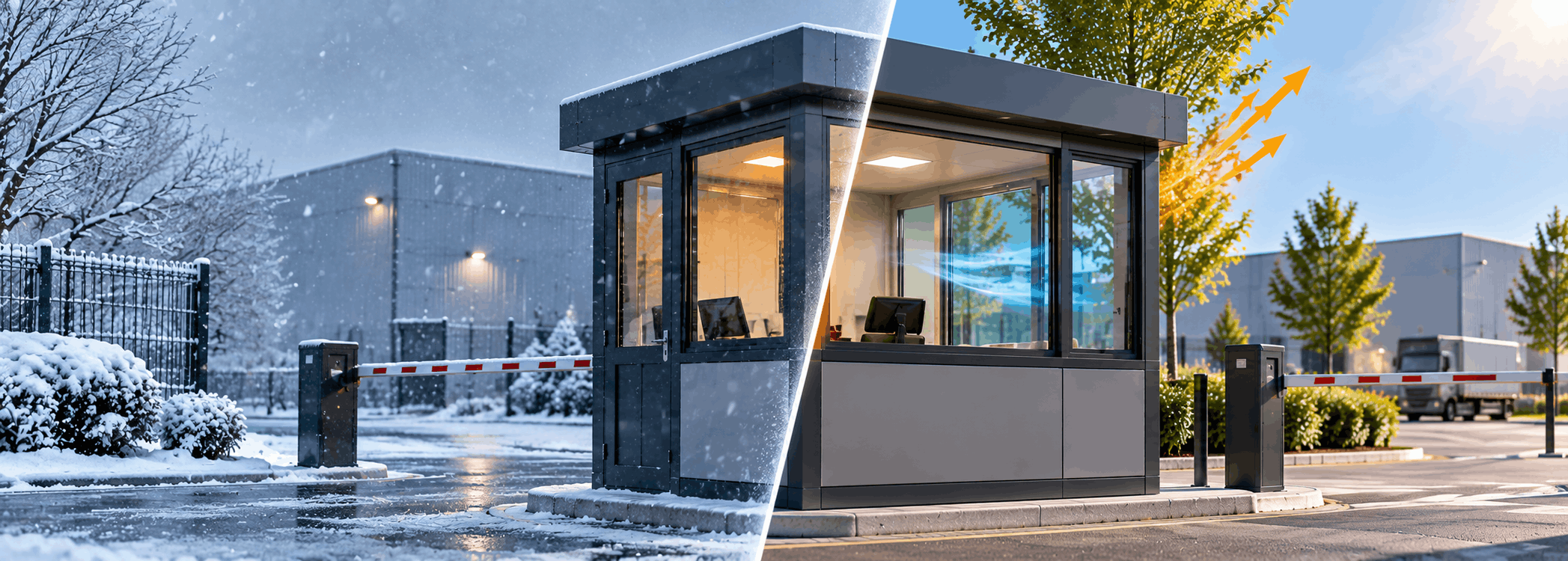
Security cabins are often positioned in some of the most exposed parts of a site. Whether located at the entrance to an industrial estate, logistics centre, construction site or commercial facility, a guard post may face wind, rain and low temperatures throughout the British winter, followed by warmer conditions during summer.
For security personnel spending long shifts inside these buildings, thermal comfort is not simply a matter of convenience. A cabin that becomes excessively cold, overheated or affected by condensation can create an uncomfortable working environment and make day-to-day operations more difficult.
Good security cabin insulation therefore needs to be considered alongside glazing, ventilation, heating and the overall construction of the building.
This guide examines the main factors UK businesses should consider when specifying a security cabin for comfortable year-round use.
Why Insulation Matters in a Security Cabin
A security cabin is typically much smaller than a conventional office, but that does not mean thermal performance is less important.
In fact, compact standalone buildings can be particularly sensitive to external temperature changes.
Security cabins may also be occupied for eight, twelve or even twenty-four hours a day depending on how the site operates. This means internal conditions can directly affect employees for extended periods.
Effective insulation can help reduce heat transfer through the building envelope, allowing the internal environment to remain more stable.
During winter, insulation helps retain heat generated by the heating system. During warmer periods, it can also help reduce the rate at which external heat enters the cabin.
However, insulation should not be considered in isolation. Windows, doors, ventilation and air leakage can all influence the final performance of the building.
Consider the Entire Building Envelope
When discussing insulation, attention often focuses on walls.
The walls are important, but they are only one part of the thermal envelope.
- A security cabin typically includes:
- external walls;
- a roof;
- a floor;
- windows;
- an entrance door;
- service penetrations.
- Heat can move through any of these areas.
A cabin with well-insulated walls but poorly performing windows may still lose significant heat. Similarly, gaps around doors can create draughts even when the wall system itself performs well.
The best approach is therefore to consider the cabin as a complete structure.
For projects where insulated panel construction is particularly important, a Sandwich Panel Cabin can provide a practical solution for security, office and site applications where thermal performance and a robust building envelope are required.
Wall Insulation and Material Selection
The construction system used for a security cabin will influence its thermal characteristics.
Different projects may use insulated panels, GRP-based systems or other prefabricated construction methods.
The correct choice depends on factors such as:
- intended use;
- operating hours;
- location;
- exposure;
- maintenance requirements;
- expected service life.
It is important to look beyond the exterior appearance of the cabin.
Two units with similar dimensions can perform very differently if their wall, roof and glazing specifications are not equivalent.
Businesses comparing security cabins should therefore review the complete technical specification rather than making a decision based solely on cabin size or visual design.
Roof Insulation Is Easy to Overlook
The roof can have a significant effect on internal comfort.
During colder periods, inadequate roof insulation can contribute to heat loss. In summer, solar exposure can increase the temperature of the roof surface and affect the interior.
This becomes particularly noticeable in small buildings because there is less internal volume to absorb temperature changes.
A well-designed roof system should therefore complement the thermal performance of the walls.
Roof design should also account for British rainfall.
Water needs to drain effectively rather than collect on the structure, while joints and seals should be capable of maintaining weather resistance over time.
Floor Insulation Can Improve Comfort
The floor is another area that may be overlooked when specifying a security cabin.
Cabins positioned on concrete bases or other cold surfaces can experience heat transfer through the floor.
This may make the internal environment feel colder, particularly during long winter shifts.
Floor construction and insulation should therefore be considered alongside the rest of the building envelope.
The foundation or supporting surface can also influence moisture management around the cabin.
Good drainage around the installation area helps prevent standing water and reduces unnecessary exposure of the lower parts of the building to persistent moisture.
Windows Can Become a Thermal Weak Point
Security cabins often contain more glazing than conventional small buildings because guards need clear views of the surrounding site.
This makes window specification particularly important.
Large glazed areas can affect both heat loss and solar gain.
The glazing should therefore provide the visibility required for security operations while supporting the overall thermal performance of the cabin.
Window frames and seals also matter.
Even good glazing can perform poorly if there are gaps around the frame or damaged seals that allow cold air to enter.
Regular inspection can help identify problems before they begin to affect comfort.
Managing Heat Loss Around Doors
Security cabins at busy entrances can have doors opening frequently throughout the day.
Every time the door opens during cold weather, warm internal air can escape.
This is particularly relevant where guards regularly leave the cabin to inspect vehicles or communicate with visitors.
The entrance should therefore be positioned carefully.
Where possible, the layout should avoid exposing the doorway directly to prevailing winds.
Good-quality door seals can also help reduce unwanted air leakage when the door is closed.
For cabins operating continuously, relatively small improvements in door performance can make a noticeable difference to internal comfort.
Condensation: A Common Challenge in Small Cabins
Condensation deserves particular attention in the UK climate.
During colder weather, warm moist air inside a cabin can come into contact with cold surfaces such as windows or poorly insulated sections of the structure.
When the surface temperature is low enough, moisture can condense.
Several factors can contribute to this problem:
occupants breathing inside a small enclosed space;
wet coats and footwear;
kettles or other refreshment facilities;
inadequate ventilation;
cold glazing;
thermal bridges.
Simply increasing the heating does not necessarily solve condensation.
The building needs an appropriate balance between insulation, heating and ventilation.
Ventilation Is as Important as Insulation
It is possible to focus so heavily on retaining heat that ventilation receives insufficient attention.
Security personnel still require fresh air.
Electronic equipment such as CCTV monitors, computers and access-control systems can also generate heat.
During summer, a compact cabin containing one or two people and several pieces of electronic equipment can become uncomfortable relatively quickly.
Ventilation therefore needs to be planned as part of the overall environmental strategy.
Depending on the cabin and its intended use, this could involve opening windows, dedicated ventilation systems or other climate-control solutions.
A GRP Kiosk Modular Cabin can be considered for applications where a durable, weather-resistant cabin is needed for security and similar operational uses.
The important point is that the environmental specification should match the way the cabin will actually be occupied.
Heating a Security Cabin Efficiently
Because security cabins are relatively compact, heating systems do not necessarily need to be large.
However, the correct heating requirement depends on several factors.
- These include:
- cabin dimensions;
- insulation performance;
- amount of glazing;
- external temperature;
- frequency of door opening;
- number of occupants;
- operating hours.
An oversized heating system may create unnecessary energy consumption or make temperature control difficult.
An undersized system may struggle during colder periods.
Rather than choosing heating equipment independently, it should be considered alongside the thermal performance of the cabin.
A better-insulated building may require less energy to maintain comfortable conditions.
Avoiding Overheating During Summer
British summers may be less consistently hot than those in some climates, but security cabins can still overheat.
Large windows can allow substantial solar gain, particularly when the cabin receives direct sunlight for much of the day.
Electronic equipment and occupants also generate heat.
The aim should be year-round comfort rather than designing exclusively for winter conditions.
The Importance of Cabin Position
Where the security cabin is installed can influence its internal environment.
A unit positioned in an exposed location may experience stronger winds and more wind-driven rain.
Another cabin positioned beside a large building may receive more shelter but less natural light.
Orientation can also determine how much direct sunlight enters through windows.
These factors should be assessed before installation.
If several possible locations are available, thermal comfort can become one of the criteria used to choose between them.
Insulation for 24-Hour Security Operations
Sites operating around the clock require particular attention to staff comfort.
A cabin occupied continuously experiences different demands from one used for only a few hours each day.
Heating may need to operate overnight during winter, while ventilation and temperature control need to accommodate changing conditions throughout the day.
Night shifts can also involve long periods during which guards remain inside the cabin.
Providing a stable internal temperature can therefore be especially important for 24-hour security posts.
Durability should also be considered because the building and its systems will experience significantly more use.
Energy Efficiency and Operating Costs
The purchase price of a security cabin is only one part of its overall cost.
Heating and cooling requirements contribute to operating expenditure throughout the building's service life.
Improved thermal performance can help reduce unnecessary energy consumption by making it easier to maintain a stable internal temperature.
This does not mean every project needs the highest possible insulation specification.
Instead, the thermal design should reflect how frequently the cabin will be occupied and the conditions it will experience.
A cabin used continuously throughout the year has different requirements from a temporary guard post operating for a limited project.
Maintenance Helps Preserve Thermal Performance
Insulation itself may require little routine attention, but other parts of the building envelope should be inspected periodically.
Areas worth checking include:
window seals;
door seals;
roof joints;
external panels;
ventilation openings;
areas around service penetrations.
Damage to seals or joints can allow air and moisture to enter, reducing comfort even when the main insulation system remains in good condition.
Identifying minor issues early can help prevent more significant problems later.
Security Cabin Thermal Comfort Checklist
Before selecting or specifying a cabin, consider the following questions:
Will the cabin be occupied throughout the year?
Will guards work overnight?
How many people will normally use the cabin?
How much glazing is required?
What wall and roof insulation is provided?
Has floor performance been considered?
How frequently will doors be opened?
What heating system will be used?
How will the cabin be ventilated?
Could direct sunlight cause overheating?
How will condensation be controlled?
Is the cabin located in a particularly exposed part of the site?
These questions can help identify environmental requirements before the cabin is ordered.
Creating a Comfortable Security Cabin for UK Conditions
A well-designed security cabin should provide more than protection from rain.
It should offer a stable and practical working environment for the people responsible for managing site access.
For UK locations, this means considering insulation alongside glazing, ventilation, heating, weather exposure and moisture management.
Wall and roof construction are important, but doors, windows and floors can also influence thermal performance. Similarly, retaining heat during winter should not come at the expense of ventilation or summer comfort.
The most effective specification will depend on how the cabin is used.
A temporary daytime security post may require a relatively straightforward solution, while a 24-hour guard cabin at an exposed industrial site may justify a more comprehensive thermal specification.
By considering the building envelope and internal environment as a complete system, businesses can create security cabins that remain comfortable, functional and energy-conscious throughout changing British weather conditions.

 EN
EN
 DE
DE
 ES
ES
 PT
PT
 RU
RU
 AR
AR
 GR
GR
 RO
RO
 KA
KA
 CS
CS