Industrial estates are busy environments where people, vehicles, contractors and deliveries can enter and leave throughout the working day. For site operators, managing this movement efficiently is an important part of maintaining a secure and well-organised facility. A purpose-designed security cabin can provide a dedicated point from which security personnel can monitor entrances, verify visitors and support day-to-day access control.
However, choosing a security cabin for an industrial estate involves more than simply selecting a small building and positioning it beside the entrance. Location, visibility, internal layout, thermal comfort, construction materials and the security equipment used inside the cabin can all affect how effectively the facility operates.
This guide explores the key considerations for specifying security cabins for industrial estates in the UK.
Why Security Cabins Matter on Industrial Estates
Industrial estates can contain warehouses, manufacturing facilities, distribution centres, workshops and commercial units. Depending on the size of the site, hundreds of employees, delivery vehicles and visitors may pass through the entrance every day.
A security cabin creates a clearly defined control point between the public-facing entrance and the operational areas of the estate.
Security personnel working from the cabin may be responsible for tasks such as:
- checking visitor identification;
- recording vehicle registrations;
- issuing visitor or contractor passes;
- monitoring CCTV systems;
- communicating with employees;
- managing delivery access;
- operating gates or barriers;
- responding to security incidents.
Centralising these responsibilities can help businesses establish more consistent access procedures while giving security teams an appropriate working environment.
For locations where a higher level of physical protection may be required, an Armored Cabin can also be considered as part of the wider security infrastructure.
Choosing the Right Location for a Security Cabin
The position of the cabin can significantly influence its effectiveness.
In many industrial estates, the most practical location is close to the main vehicle entrance. This allows security personnel to communicate with drivers before they enter operational areas.
However, the cabin should not obstruct vehicle movements or create unnecessary congestion.
Site planners should consider several factors when determining its position.
Visibility
Security staff should ideally have a clear view of approaching vehicles, pedestrians, gates and surrounding areas.
Large windows can improve sightlines, but their positioning should be considered carefully. Poorly positioned glazing may create blind spots or reflections that make CCTV screens difficult to monitor.
Vehicle Flow
Industrial sites often receive HGVs, vans and passenger vehicles simultaneously.
The cabin should therefore be positioned so that security checks do not interfere with turning circles, loading areas or emergency access routes.
Where possible, separate lanes can be created for employees, visitors and commercial vehicles.
Pedestrian Access
Visitors arriving on foot should not need to cross busy vehicle lanes unnecessarily.
A well-designed entrance can incorporate safe pedestrian routes leading directly to the security point.
Selecting the Appropriate Cabin Design
Not every industrial estate requires the same type of security building.
A small facility with limited traffic may only require a compact guard cabin, while a large logistics centre operating around the clock may require a larger unit capable of accommodating several security personnel and monitoring systems.
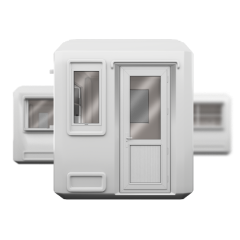
GRP-based structures can be particularly useful where businesses need lightweight, durable and easily maintained cabin solutions. A GRP Kiosk Modular Cabin, for example, can support a variety of security and access-control applications.
When comparing cabin designs, businesses should consider both current requirements and potential future expansion.
Installing a cabin that only accommodates today's requirements may create limitations if CCTV equipment, access-control technology or additional personnel need to be introduced later.
Internal Layout and Workspace Planning
Security cabins are workplaces, and their internal layout should reflect the tasks employees need to perform.
- A practical layout might include:
- a workstation or desk;
- CCTV monitors;
- access-control equipment;
- communications systems;
- visitor documentation storage;
- lockers;
- electrical sockets;
- heating and cooling equipment.
Equipment should be positioned so that security staff can operate systems without losing visibility of the entrance.
For example, placing CCTV monitors directly against a window may cause glare during daylight hours. Similarly, positioning a desk too far from the vehicle window may make communication with drivers unnecessarily difficult.
Ergonomics also matters, particularly at sites where guards work long shifts.
Thermal Comfort in the UK Climate
British weather presents its own challenges for small standalone buildings.
Security cabins may be occupied throughout winter, during periods of heavy rain and on warmer summer days. Appropriate insulation therefore plays an important role in maintaining a comfortable internal environment.
Walls, roofs, doors and windows should be specified with thermal performance in mind.
Heating may be required during colder months, while ventilation or cooling can help maintain comfortable working conditions during summer.
The entrance door also deserves consideration. At particularly busy facilities, frequent opening and closing can lead to substantial heat loss.
Good insulation and appropriately specified glazing can help reduce this problem.
Lighting and Electrical Requirements
Modern security cabins often depend heavily on electrical equipment.
CCTV systems, computers, barrier controls, intercoms, lighting and communication equipment may all operate from the cabin.
The electrical specification should therefore be established before installation rather than treated as an afterthought.
Internal lighting should provide comfortable working conditions without creating excessive reflections on windows or CCTV monitors.
External lighting may also improve visibility around entrance areas during night shifts.
For industrial estates operating 24 hours a day, lighting design becomes particularly important.
Integrating CCTV and Access-Control Systems
Modern security cabins increasingly function as small access-control centres.
- Depending on the site, systems may include:
- CCTV monitoring;
- automatic number plate recognition;
- electronic barriers;
- intercom systems;
- visitor management software;
- access cards;
- alarm systems.
Planning these technologies alongside the cabin design can make installation considerably easier.
Cable routes, power outlets, monitor positions and equipment storage can all be incorporated before the cabin reaches the site.
This can produce a cleaner installation and reduce the need for later modifications.
Standard Security Cabin or Armoured Cabin?
The level of physical protection required should reflect the site's risk profile.
For many commercial and industrial estates, a conventional security cabin may provide an appropriate working environment for guards and access-control personnel.
However, certain locations may require additional protection.
These could include critical infrastructure sites, high-value storage facilities, sensitive industrial operations or locations where security personnel face an elevated risk.
In such situations, an armoured security cabin may form part of a broader protective strategy.
The decision should be based on a site-specific security assessment rather than assuming that the highest level of protection is necessary for every project.
Maintenance and Long-Term Performance
Security cabins are often positioned in exposed locations where they experience rain, wind, dirt and frequent daily use.
Maintenance requirements should therefore be considered during the specification process.
Exterior surfaces should be easy to clean, while doors, windows and seals should be inspected periodically.
Drainage around the cabin is also important. Standing water near the base of the structure can create unnecessary maintenance issues over time.
Choosing materials suited to the operating environment can reduce maintenance requirements and help extend the usable life of the cabin.
Planning for Future Security Requirements
Security technology changes quickly.
A cabin installed today may eventually need additional cameras, larger monitoring systems, new access-control equipment or space for another member of staff.
Allowing some flexibility in the initial design can make these changes easier to accommodate.
Businesses should therefore consider not only what the security team needs today, but what the entrance may look like several years from now.
This is particularly relevant for industrial estates expecting increased tenant numbers, additional warehouse capacity or higher vehicle volumes.
Choosing a Security Cabin for Your UK Industrial Site
An effective security cabin should support the wider security strategy of the site rather than operate as an isolated structure.
Its location should provide good visibility, its layout should support security personnel, and its specification should reflect the environmental and operational conditions of the facility.
For UK industrial estates, considerations such as insulation, weather resistance, glazing, electrical infrastructure and long-term maintenance can be just as important as the physical dimensions of the cabin.
Most importantly, the cabin should be selected according to the actual risk profile and operational requirements of the site.
By considering these factors early in the planning process, businesses can create an entrance control point that supports efficient visitor management, vehicle monitoring and day-to-day site security while providing security personnel with a practical working environment.

 EN
EN
 DE
DE
 ES
ES
 PT
PT
 RU
RU
 AR
AR
 GR
GR
 RO
RO
 KA
KA
 CS
CS


