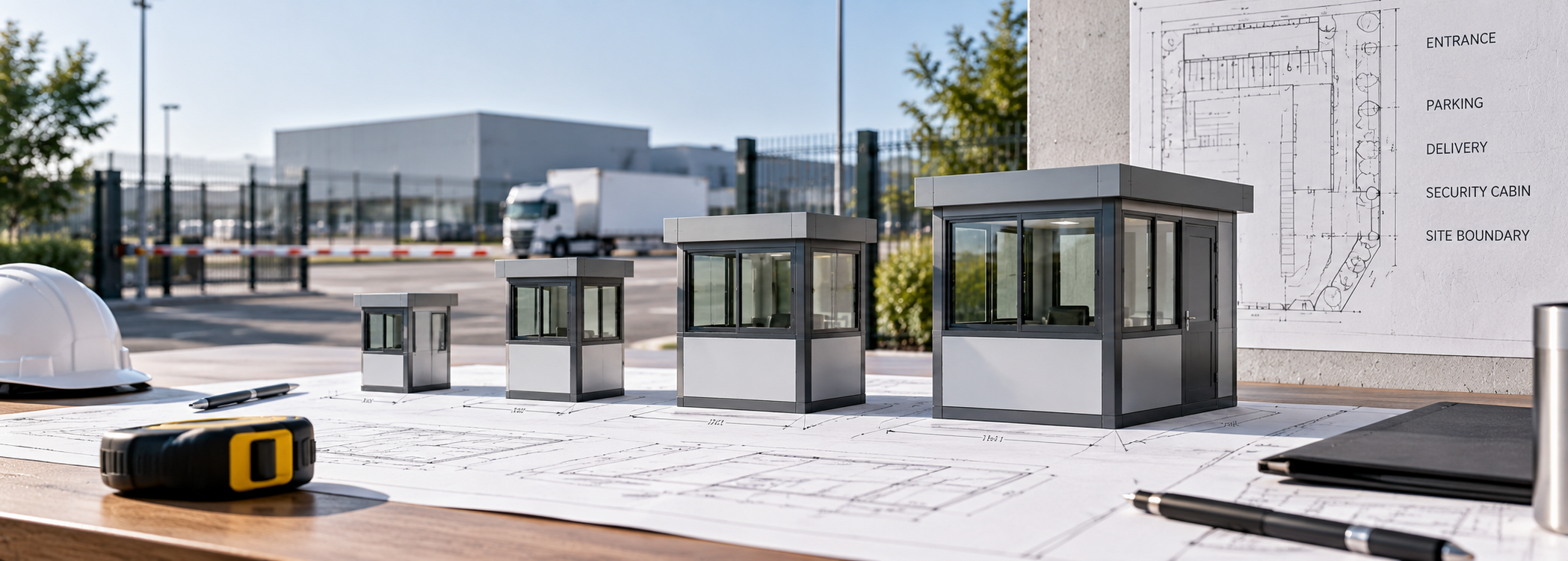
Choosing the right security cabin size is an important part of planning an effective access-control point. A cabin that is too small can quickly become uncomfortable once desks, CCTV monitors, communication equipment and storage are installed. An unnecessarily large cabin, on the other hand, may occupy valuable space around an entrance and increase project requirements without delivering a practical benefit.
For UK construction sites, industrial estates, logistics centres, commercial premises and gated facilities, the appropriate security cabin size depends on much more than the number of guards working inside.
Vehicle movements, visitor volumes, security equipment, shift patterns and the physical layout of the site should all influence the decision.
This guide explains the main factors to consider when choosing a security cabin size and how to plan a practical workspace around your site's operational requirements.
Start with the Number of Security Personnel
The first consideration should be how many people will normally use the cabin at the same time.
A compact cabin may be suitable for a site where one security guard manages a relatively quiet entrance. The space may only need to accommodate a chair, small desk, communication equipment and basic storage.
Requirements change considerably when two or more security personnel work simultaneously.
Additional employees mean additional seating and workspace, but the cabin also needs sufficient circulation space. Guards should be able to enter, leave and move around the cabin without navigating around equipment or obstructing colleagues.
Shift patterns should also be considered.
A site may normally employ one guard but require two security personnel during shift changes, peak delivery periods or major events. Designing exclusively around the lowest occupancy level can therefore create problems later.
Consider What Equipment Will Be Inside
Modern security cabins are rarely empty guard posts.
Depending on the facility, a cabin may contain:
- CCTV monitors;
- computers;
- visitor management systems;
- radios and telephones;
- barrier controls;
- access-card systems;
- alarm panels;
- filing and document storage;
- lockers;
- heating or cooling equipment.
Every piece of equipment requires space.
CCTV installations are particularly important when calculating cabin dimensions. A site with several cameras may require multiple screens or a larger monitoring display. These should be positioned where guards can view them comfortably without losing sight of the entrance.
Businesses planning more sophisticated security operations should therefore create an equipment list before selecting a cabin.
Match Cabin Size to the Site Entrance
The largest cabin is not automatically the best option.
The building must fit naturally into the entrance layout without restricting traffic.
This is particularly important at logistics facilities, warehouses and industrial sites where HGVs need sufficient space to turn and manoeuvre.
- Before selecting a cabin, assess:
- road width;
- vehicle turning areas;
- pedestrian routes;
- gate position;
- barriers;
- emergency access;
- delivery waiting areas.
A well-positioned compact cabin can often be more effective than a larger building placed in an inconvenient location.
Where the entrance has limited available space, a purpose-designed solution such as a Metro City Cabin can provide a practical starting point for planning a dedicated security or control space.
Think About Vehicle and Visitor Volumes
A quiet commercial site and a busy distribution centre have very different access-control requirements.
If only a small number of vehicles arrive each day, guards may primarily monitor the gate and occasionally communicate with visitors.
At a busy site, the cabin could become an administrative hub.
- Security personnel may need to:
- check driver documentation;
- contact warehouse teams;
- register contractors;
- issue visitor passes;
- manage vehicle queues;
- monitor CCTV;
- operate barriers.
More activity generally means more equipment, documentation and workspace.
A larger cabin may therefore be justified even when only one or two guards are present.
Decide Whether Visitors Need to Enter the Cabin
Some security cabins operate entirely through service windows.
Others include a visitor-facing area where contractors, employees or delivery drivers can complete documentation.
This distinction can have a major impact on the required floor area.
If members of the public need to enter, the layout should allow them to do so without interfering with the security team's working area.
For higher-volume facilities, creating a dedicated visitor section or reception point can make the entrance process more organised.
Where interactions take place through an external window, the cabin can often remain more compact.
Plan the Internal Layout Before Choosing Dimensions
One of the easiest ways to choose the wrong cabin size is to select dimensions before thinking about the internal layout.
Instead, begin by sketching where key items will be positioned.
- Consider the location of:
- desks;
- chairs;
- CCTV screens;
- windows;
- doors;
- electrical sockets;
- storage;
- heating equipment.
Then consider how people will move around these elements.
A cabin may appear large enough on paper but become restrictive once furniture and security technology are installed.
Planning the interior first makes it easier to determine the dimensions needed for comfortable day-to-day operation.
Window Position Can Affect Usable Space
Windows are essential in many security cabins because they provide direct visibility of the surrounding site.
However, extensive glazing can reduce the amount of wall space available for monitors, storage and electrical equipment.
The solution is not necessarily to reduce the number of windows. Instead, glazing should be positioned according to the security team's sightline requirements.
- Guards may need clear views towards:
- approaching vehicles;
- pedestrian gates;
- barriers;
- car parks;
- loading areas.
The remaining walls can then be used for equipment and storage.
This balance between visibility and usable internal space should be considered at the design stage.
Do You Need Additional Facilities?
Security personnel working long shifts may require more than a desk and chair.
Depending on the site and the availability of nearby welfare facilities, the cabin may need space for:
- a small refrigerator;
- kettle;
- storage cupboards;
- lockers;
- coat storage;
- basic refreshment facilities.
If toilets or rest areas are provided elsewhere on the site, they may not need to be incorporated into the security building.
However, remote entrances can be located a considerable distance from the main facility. In those circumstances, a larger cabin or additional welfare provision may be appropriate.
Consider UK Weather Conditions
Security cabins are commonly located at exposed entrances.
In the UK, this means they must provide a comfortable working environment during cold, wet and windy periods as well as warmer summer weather.
Insulation, glazing, ventilation and heating all influence internal comfort.
Cabin dimensions can also affect thermal performance. Larger spaces generally require more energy to heat, while very compact cabins containing several people and electronic devices may become warm quickly.
The building envelope therefore matters as much as floor area.
For projects where thermal performance and flexible dimensions are priorities, a Sandwich Panel Cabin can be considered as part of the specification process.
Allow for Future Expansion
Another common mistake is selecting a cabin based entirely on current requirements.
Security operations may expand as the site grows.
- A business could introduce:
- additional CCTV cameras;
- automatic number plate recognition;
- electronic visitor management;
- additional barriers;
- more security personnel.
If the cabin has no spare capacity, even a relatively small technology upgrade can create an overcrowded workspace.
Businesses expecting growth should consider whether slightly more internal space today could prevent the need to replace or significantly modify the cabin later.
Small, Medium or Large Security Cabin?
There is no universal size that works for every site.
A smaller security cabin can be suitable for a single guard managing a straightforward entrance with limited equipment.
A medium-sized unit may be more appropriate where one or two guards need desks, CCTV monitoring and storage.
Larger cabins become useful where several employees work simultaneously or where the building combines security monitoring with visitor registration, access administration and other functions.
The correct choice should therefore be based on operational requirements rather than an arbitrary size category.
Security Cabin Size Checklist
Before making a final decision, consider the following questions:
How many guards will work inside at the same time?
Will additional personnel use the cabin during shift changes?
How many CCTV screens are required?
What access-control equipment will be installed?
Do visitors need to enter the building?
Is document or equipment storage required?
Are welfare facilities available nearby?
How much space is available at the entrance?
Could the site's security requirements expand?
Will the cabin operate continuously or only during specific hours?
Answering these questions provides a much more reliable basis for choosing dimensions than simply selecting a standard unit based on appearance.
Choosing the Right Security Cabin for Your UK Site
The right security cabin should be large enough to support the people and technology operating inside it without occupying unnecessary space around the entrance.
For smaller sites, a compact cabin may provide everything required for access control and visitor management. Busy industrial or logistics facilities may need more substantial accommodation to support CCTV monitoring, administration and multiple security personnel.
The most effective approach is to define how the cabin will actually be used before deciding on its dimensions.
Consider staffing, equipment, visitor interaction, available site space and future security requirements together. This creates a much clearer specification and reduces the risk of choosing a cabin that becomes unsuitable once the site is operational.
Ultimately, security cabin size should support the wider objective of the entrance: allowing authorised people and vehicles to move efficiently while giving security personnel a practical, comfortable and well-organised place from which to manage access.

 EN
EN
 DE
DE
 ES
ES
 PT
PT
 RU
RU
 AR
AR
 GR
GR
 RO
RO
 KA
KA
 CS
CS