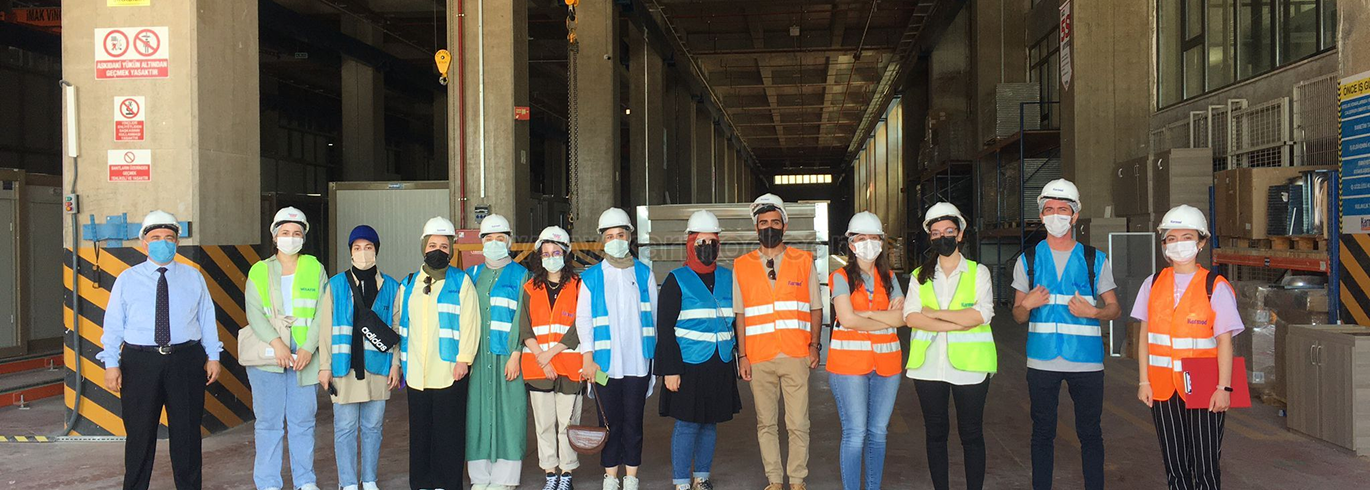
The Covid-19 pandemic caused a major disruption in education systems worldwide, leaving millions of students unable to attend their schools for an extended period. In response to this challenge, students from Istanbul Medipol University’s Faculty of Fine Arts, Design and Architecture launched a remarkable project aimed at supporting the continuation of uninterrupted face-to-face education during pandemic conditions.
As part of their summer internship program, Architecture Faculty students, under the guidance of Faculty Member Dr. Şehnaz Cenani Durmazoğlu, began developing container-based classroom and social space concepts for the university campus. Before starting the design phase of the “Covid-Free Container Classrooms and Social Areas Project,” the student team visited Karmod to gain detailed information about container structures and their potential applications. During the visit, Karmod Sales and Marketing Manager Abdullah Yüceer accompanied the delegation, which consisted of 12 students.
The program started with a comprehensive presentation held in the factory’s training hall. Students were introduced to the technical specifications, dimensions, and modular combination possibilities of container systems. Special attention was given to the design principles and practical considerations required for creating Covid-safe educational environments that could contribute significantly to maintaining face-to-face learning. During the presentation, Karmod’s next-generation container school solutions were also showcased, including educational facilities previously delivered in France, Malta, Nigeria, Libya, Cameroon, and Türkiye.
Following the presentation and a brief occupational health and safety training session, the students had the opportunity to tour the production facilities and closely observe the manufacturing processes of container units.
The student team plans to establish a Covid-Free Container Education Complex with a capacity of approximately 200 students on their university campus as the first stage of the project. In addition to classroom areas, the concept includes a variety of social and support facilities designed to meet student needs. The internship project currently incorporates workshops, a cafeteria, kitchen facilities, restrooms, and storage areas, creating a comprehensive educational environment within a modular container-based structure.


 EN
EN
 DE
DE
 ES
ES
 PT
PT
 RU
RU
 AR
AR
 GR
GR
 RO
RO
 KA
KA
 CS
CS